 AlignJobs
- 5K+ Users
- Product
- Remote jobs
- Indonesia
TL;DR
AlignJobs is a remote job platform built for Indonesian job seekers. I worked solo across product, development, and growth, testing the idea on Threads before launching the first version in 2 days.
Within 20 days of launch, it reached 5,000+ registered accounts. To date, 92 users have upgraded to Pro.
- Role
- Founder, Product & Growth
- Timeline
- September 2026
- Team
- Solo builder
- Tools
- Next.js, Supabase, Threads, PostHog, GA4, Meta Pixel, Claude, Cursor, Apify
Background
A local starting point
While exploring remote job platforms, I noticed that many of the ones I found served a global audience, with paid plans priced in dollars. I saw room for a more affordable option built with Indonesian job seekers in mind.
Problem
An idea, not yet a proven need
Price and local relevance were the gaps I wanted to explore. But noticing an opportunity did not tell me whether people would use the product.
Could I make remote job search more affordable for Indonesians, and would that be enough for people to try it?
Process
01. Test interest through a job seeker's lens
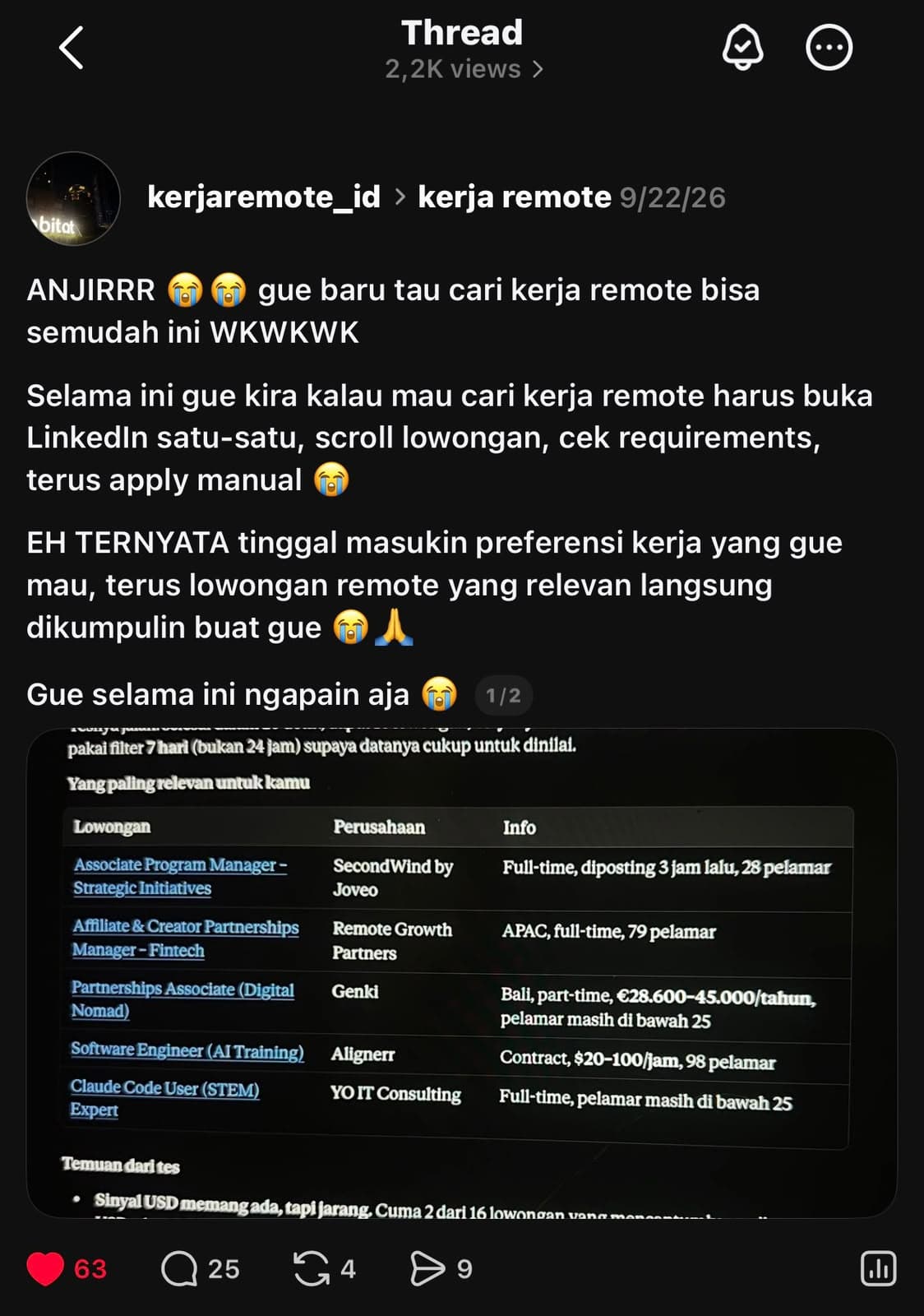
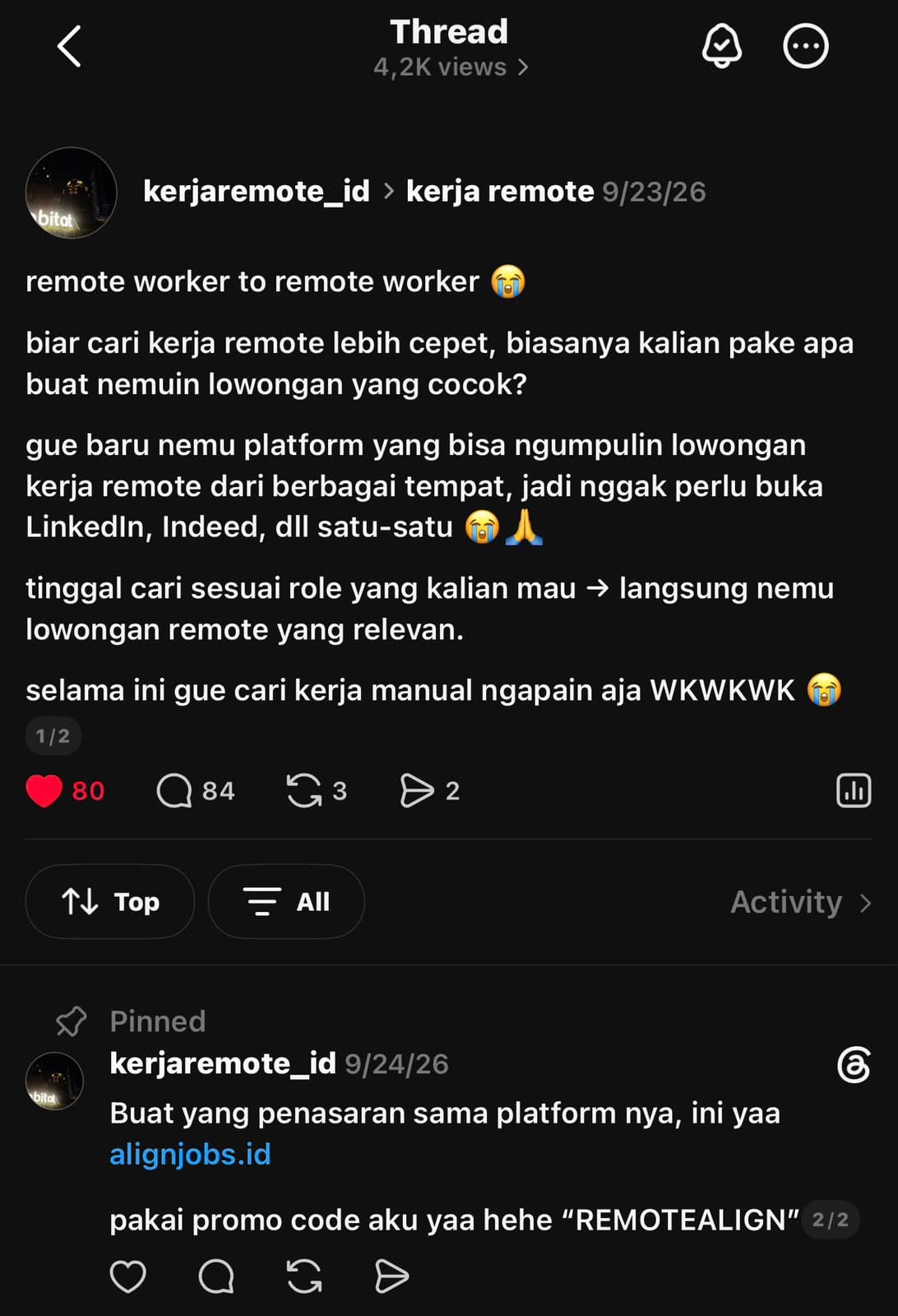
I tested interest on Threads using what I called User POV: writing from a job seeker's perspective rather than leading with a founder pitch. The posts framed the idea as a discovery, a way to find relevant remote jobs without checking other sites one by one.
These responses gave me an early signal of interest in a simpler search experience, not yet proof that people would use or pay for the product.
02. Keep the first version small
I built and launched the first version in 3 days using Claude Code, Next.js, and Supabase. I focused on job search and left additional features for later so I could learn from actual usage.
After launch, I tested the onboarding and paywall to understand how people got started and responded to the paid offer.
03. Build distribution beyond a brand account
I ran multiple Threads accounts instead of relying on a single brand account.
At this stage, I saw mass distribution as a stronger path to growth than relying on a single brand account. Running multiple accounts gave me more opportunities to put AlignJobs in front of potential users, rather than depending on one account to reach everyone.
The idea was to combine broader reach with a more personal approach: introduce the product through relatable job search experiences, so the posts felt more like recommendations than brand promotions.
In 20 days, the app grew from 0 to 5,000+ registered accounts. On best day, 800 users signed up, and 92 users have upgraded to Pro so far. My best performing post reached 500,000 views.
04. Track what happens from onboarding to Pro
I set up tracking from launch to understand where visitors came from and what they did inside the app.
I built a dashboard to bring the key metrics together and review them daily. It covers acquisition, the user lifecycle, engagement, and Pro user retention. Free user retention is not yet tracked. I also track operations (job listings) and engineering (scraping), all on my own.
These charts help me make better decisions rather than build on assumptions.
Product
AlignJobs: remote job search for Indonesians
The first release turned the idea into a working web app, with an affordable, locally focused approach to remote job search.
Impact
5,000+ accounts in 20 days, built solo
Within its first month, AlignJobs became my most successful app so far, reaching 5,000+ registered accounts in 20 days. To date, 92 users have upgraded to Pro, providing an early signal of willingness to pay alongside the growth in registrations.
Reflections
1. Validate before building
I used Threads to gauge interest in finding remote jobs before investing time in development. Early responses helped me validate the problem and decide whether it was worth building a solution.
2. Distribution is part of product strategy
I experimented with multiple Threads accounts to test different content angles, from relatable job search frustrations to discovering remote job resources. This helped me explore how distribution could drive awareness and user acquisition alongside product development.
3. Signups are only the beginning
Reaching 5,000 accounts showed that people were interested in AlignJobs, but signups alone couldn't tell me whether users found relevant jobs or returned to the platform. My next step is to track activation, repeat visits, and engagement to understand what drives long term value.